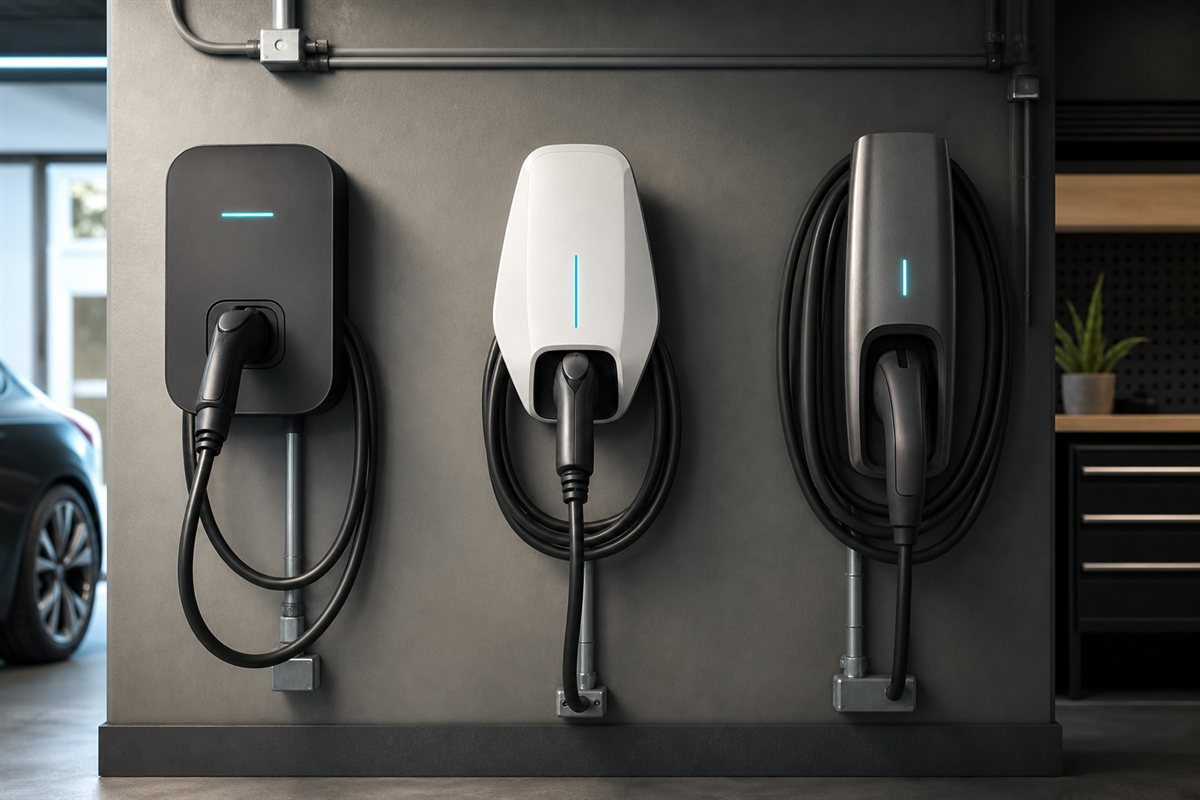
Quick answer: the biggest winter fix is free. Warm the car while it is still plugged in, so the heat comes from the wall and not the battery. Hardware only matters if you charge outside or rely on a slow outlet. If so, look for a UL-listed Level 2 unit whose listing explicitly covers outdoor use and cold. The ChargePoint Home Flex lists a cold-resistant cable. The Grizzl-E Classic says it is IP67 and "suitable for normal and cold weather." The Emporia lists a NEMA 4 rating.
What Cold Weather Actually Does to an EV
fueleconomy.gov's cold-weather page says EV fuel economy can drop roughly 39% in mixed city and highway driving at 20 °F, and range can drop by 41%. It adds that about two-thirds of the extra energy goes to heating the cabin. With the cabin heater off, the same page puts the loss at about 8% for efficiency and about 12% for range at 20 °F compared with 75 °F.
That split is the useful part. Most of the winter penalty is heat for the people inside, not a battery that has stopped working. The rest comes from physics the same page lists. Cold air is denser, which raises aerodynamic drag at highway speed. Tire pressure drops, which raises rolling resistance. A cold battery also performs worse, and that affects regenerative braking.
Five Free Habits That Recover the Most Range
- Precondition while plugged in. fueleconomy.gov notes that pre-heating the cabin while the car is on the charger can extend range. The heating energy comes from the grid instead of the pack. Schedule it for your departure time in the vehicle app.
- Use the seat and wheel heaters first. The same page recommends seat warmers over the cabin heater because they use less energy.
- Park somewhere warmer. A garage, even an unheated one, starts the car at a higher temperature than the driveway.
- Check tire pressure after every cold snap. Pressure falls as the temperature falls. Our EV tire pressure guide covers how to set it from the door-jamb placard, not the sidewall.
- Precondition before a fast charger. On a road trip, navigate to the charging stop in the car so it can warm the battery on the way. Our new-owner checklist explains why this shortens cold fast-charging sessions.
To put a dollar figure on winter driving, enter a lower efficiency in the charging-cost calculator. Take your summer mi/kWh and cut it by the share you see on your own winter trip meter.
Why Winter Exposes a Slow Outlet
The Department of Energy's Alternative Fuels Data Center notes that many drivers meet their daily needs by charging overnight on Level 1, from a standard 120-volt outlet on a dedicated circuit. That stays true in winter for short commutes. The margin shrinks, though, because every bit of preconditioning, and every extra kilowatt-hour a cold car uses per mile, has to come through the same outlet.
The arithmetic is simple. A 120 V outlet at 12 A continuous delivers 1.44 kW. That is 14.4 kWh at the wall over a ten-hour night, before charging losses. A 240 V circuit at 40 A delivers 9.6 kW, so the same night has far more room for heat and range. If your winter mornings start below the charge you wanted, the outlet is the bottleneck. The outlet range estimator shows what your specific outlet adds per night. The panel conversation estimator helps you prepare before you call an electrician about a 240 V circuit.
Cold-Ready Level 2 Home Chargers
The table lists only what each current listing says about cold, outdoor use, enclosure rating and certification. AFDC notes that outdoor installs are safe, even in rain, but only with outdoor-rated equipment. Match the connector (NACS or J1772) to the car, and the plug (NEMA 6-50, NEMA 14-50 or hardwired) to the circuit.
| Charger (variant) | Connector · install | Cold / outdoor language in the listing | Certification stated |
|---|---|---|---|
| ChargePoint Home Flex (NACS, 6-50 plug) | NACS · NEMA 6-50 on a 40A or 50A circuit | Cold-resistant cable; indoor or outdoor install by an electrician | UL-certified |
| ChargePoint HomeFlex (J1772, 14-50 plug) | J1772 · NEMA 14-50 on a 40A or 50A circuit; Teslas need an adapter | Cold-resistant cable; indoor or outdoor install by an electrician | UL-certified |
| Grizzl-E Classic | J1772 · NEMA 14-50; 40/32/24/16A settings; 24-ft cable | "Suitable for normal and cold weather"; IP67; indoor/outdoor | UL certified; built-in GFCI |
| Emporia Level 2 | J1772 · NEMA 14-50 (40A) or hardwired (48A); 25-ft cable | NEMA 4 rated | UL listed; ENERGY STAR |
| Emporia Pro (PowerSmart) | J1772 · NEMA 14-50 or hardwired, up to 48A; load balancing | Described as weather-resistant | Listing cites Energy Star, NEMA, UL |
Read the variant, not just the brand. ChargePoint sells the same charger with different connectors and plugs under different Amazon listings. Check the part number on the listing before you order (see below).
Tesla or other NACS car, plug-in installChargePoint Home Flex — NACS, NEMA 6-50
The listing (part CPH50-NEMA6-50-L23-NACS) describes a UL-certified Level 2 charger with a native NACS connector. It plugs into a NEMA 6-50 receptacle on a 40A or 50A circuit, can be installed indoors or outdoors by an electrician, and "includes a cold-resistant cable." The listing claims up to 30 miles of range per hour. That cable note is the detail to look for if the charger will live on an outside wall.
Check the NACS ChargePoint Home Flex on Amazon →Amazon listingIf an electrician is hardwiring it instead, the hardwired NACS listing (part CPH50-HARDWIRE-L23-NACS) carries the same UL, indoor/outdoor and cold-resistant-cable language.
Check the hardwired NACS version on Amazon →Amazon listing J1772 car that charges outdoorsGrizzl-E Classic
Of the listings in this group, the Grizzl-E Classic's says the most about weather. The listing calls it "suitable for normal and cold weather," UL certified and IP67, with a metal case for indoor or outdoor use. Grizzl-E's own FAQ describes an air-tight UL Type 4 cast-aluminum enclosure that "takes on cold and heat, snow and rain." The listing gives four current settings: 40A on a 50A breaker, 32A on 40A, 24A on 30A and 16A on 20A. The cable is 24 feet and the unit has a built-in GFCI. It has a J1772 connector, so a Tesla needs an AC adapter (see adapters).
Check the Grizzl-E Classic on Amazon →Amazon listing Smart scheduling for off-peak winter nightsEmporia Level 2 (J1772)
The Emporia listing states UL listing, ENERGY STAR certification and a NEMA 4 rating. It runs at 40A on the included NEMA 14-50 plug or up to 48A when hardwired, with a 25-foot cable. It connects over 2.4 GHz Wi-Fi to schedule sessions, which helps when a time-of-use rate makes overnight power cheaper.
The same unit is also sold in black (Amazon listing).
Check the Emporia EV charger on Amazon →Amazon listing Tight panel, cold-season heating loadEmporia Pro with PowerSmart
Winter is when electric heat, a heat pump or a dryer competes with the car for panel capacity. The Emporia Pro listing describes PowerSmart load balancing that "works with your existing electrical panel to automatically balance load." It is also sold with an Emporia Vue energy monitor, takes a NEMA 14-50 plug or a hardwired connection, and runs up to 48A. Before buying, read our panel-capacity guide, then confirm with an electrician that load management fits your installation.
Check the Emporia Pro on Amazon →Amazon listingJ1772 ChargePoint instead? The J1772 / NEMA 14-50 listing (part CPH50-NEMA14-50-L23) has the same cold-resistant cable and indoor/outdoor wording. It notes that Teslas need an adapter. Check the J1772 ChargePoint on Amazon (Amazon listing). Prefer Tesla's own hardware? The full comparison, including the Tesla Wall Connector, is on our home EV charger guide.
Cold-weather cable care: coil the cable loosely and hang it off the ground so it doesn't freeze into a puddle or get driven over. Keep the connector holstered or capped between sessions. If the charge-port latch or connector is iced, follow your vehicle manual's de-icing guidance rather than forcing it. Never run a charger through an ordinary extension cord, whatever the season.
Holiday Travel: Cold-Rated Portable Cords
Visiting family over the holidays often means charging from someone else's outlet in an unheated garage or driveway. These two listings state an enclosure rating and a certification. The full five-kit comparison is in our portable EV charger guide.
Adapters That State a Cold Rating
An AC adapter lets a J1772 car use a NACS (Tesla-style) charger, or the other way round. Check the direction before you buy. Only one of the adapters VoltEdge links publishes an operating-temperature range.
A2Z Stellar — NACS charger to J1772 car. A2Z lists an operating temperature of −30 °C to 50 °C (−22 °F to 122 °F), IP67 protection (IP54 while mated), an 80A rating, dual over-temperature sensor switches and UL 2252/CSA C22.2 certification. It is AC only: A2Z says it is not compatible with NACS DC chargers.
Check the Stellar adapter at A2Z EV →A2Z EV affiliate link · 10% off with code TYLERJBLASER while activeA2Z Atom — J1772 charger to NACS car. A2Z lists AC Level 1 and 2 use at 240 VAC and 80A, an interlock, UL 2252/CSA-C22.2 certification and an IP54 rating that it says makes the adapter "suitable for charging outdoors." A2Z's page does not list an operating-temperature range for the Atom.
Check the Atom adapter at A2Z EV →A2Z EV affiliate link · 10% off with code TYLERJBLASER while activeA2Z reader discount: enter code TYLERJBLASER at checkout for 10% off while A2Z keeps that offer active. These are affiliate links; VoltEdge may earn a commission.
DC fast charging on a winter road trip? A CCS1-to-NACS adapter lets a compatible Tesla use CCS fast chargers. The LaTough listing says the adapter cuts current at 176 °F (80 °C) and stops charging at 185 °F (85 °C) until it cools. VoltEdge has not hands-on tested it.
Not compatible with Cybertruck. The LaTough listing says it does not fit the Cybertruck. Verify CCS Adapter Support on your vehicle before you buy: Controls > Software > Additional Vehicle Information. The listing notes an ECU upgrade may be required.
Winter Outages: Backup Power That Respects the Cold
Ice storms bring power outages, and they are a separate problem from charging the car. A portable power station can keep a modem, phone, CPAP or sump pump running. It is not a practical way to charge an EV. Size one with our power station picker, and compare it with a wired-in system in portable vs. home battery.
Read the charging temperature limit before storing a battery in the garage. Some batteries limit charging in the cold. For example, the ECO-WORTHY 12V 20Ah LiFePO4 listing says its BMS stops charging below 20 °F, stops discharging below −4 °F, and resumes once the battery warms to 32 °F. A station left in a freezing garage may refuse to recharge from solar until it warms up. Check each manual for its own range.
Tires, Pressure and a Roadside Kit
Cold mornings drop tire pressure, and lower pressure costs range. Snow and ice cost grip. Our EV tire guide covers winter and all-weather options, including dedicated winter sets. The tire comparison tool shows the range trade-offs.
Track What Winter Is Really Costing
The Emporia Gen 2 Vue listing describes a real-time home energy monitor with 16 circuit-level 50A sensors. It can show the charger circuit next to the furnace or heat pump, so you can see what winter is doing to each one. The sensors sit on individual circuits at the panel; have an electrician install them if you're not comfortable working there. The P3 Kill A Watt is for 115-volt plug-in appliances such as a space heater or engine-block heater. It is not for EV charging.
Check the Emporia Vue energy monitor on Amazon →Amazon listing Check the Kill A Watt meter on Amazon →Amazon listingFrequently Asked Questions
How much range does an EV lose in winter?
fueleconomy.gov reports that at 20 °F an EV's range can drop by about 41% in mixed city and highway driving, with about two-thirds of the extra energy going to cabin heat. With the cabin heater off, the range loss is about 12%. Results vary by vehicle, speed and trip length.
Should I precondition my EV while it's plugged in?
Yes. fueleconomy.gov says pre-heating the cabin while the car is plugged in can extend range, because the heating energy comes from the grid instead of the battery. Schedule it for your departure time.
Can a Level 2 charger be installed outside in snow?
The U.S. Alternative Fuels Data Center says outdoor installation and use are safe, even in rain, when the equipment is outdoor-rated. Choose a unit whose listing states outdoor use and an enclosure rating, and have a qualified electrician install it.
Is Level 1 charging enough in winter?
For short commutes it often is. AFDC notes many drivers meet daily needs on Level 1. In deep cold, though, preconditioning and higher energy use per mile both draw from the same 1.44 kW outlet. If mornings start below your target charge, a 240 V circuit is the fix.
Do EV charging adapters work in freezing weather?
Check the adapter's stated operating temperature. A2Z lists −30 °C to 50 °C for its Stellar NACS-to-J1772 adapter. If a manufacturer publishes no range, ask before relying on that adapter outdoors in deep cold.
Sources
Product details are taken from the retailer or manufacturer pages below, checked October 18, 2026. Listings change; confirm the current page before you buy.
- fueleconomy.gov — Fuel Economy in Cold Weather (EV range and efficiency at 20 °F, cold-weather tips)
- U.S. DOE Alternative Fuels Data Center — Charging Electric Vehicles at Home (Level 1 adequacy, outdoor-rated installs)
- Amazon listing B0CSPMGKV3 — ChargePoint Home Flex, NEMA 6-50, NACS
- Amazon listing B0CSPMC93Y — ChargePoint HomeFlex, Hardwired NACS
- Amazon listing B07WXZDHGV — ChargePoint HomeFlex J1772, NEMA 14-50
- Amazon listing B082LMVSLY — Grizzl-E Classic 40A and Grizzl-E FAQ
- Amazon listing B09ZNN3JB7 — Emporia Level 2 J1772 (white); black variant B09BP1GM76
- Amazon listing B0D9MQ736J — Emporia Pro with PowerSmart
- Amazon listing B0C94HPCPD — Grizzl-E Mini portable 40A
- Amazon listing B0DC6HS15W — Lectron Level 1 J1772 12A
- A2Z EV product pages: Stellar NACS-to-J1772 and Atom J1772-to-NACS
- Amazon listing B0C1RW5X4C — LaTough CCS Combo 1 to NACS
- Amazon listing B095GYPBTW — ECO-WORTHY 12V 20Ah LiFePO4 (low-temperature cut-off)
- Amazon listing B0FN7MSY4L — Anker SOLIX C1000 Gen 2
- Amazon listing B0C4DW17PD — EcoFlow DELTA 2 Max
- Amazon listing B0DB1BPFG8 — FRIWOLE tire repair kit with cordless inflator
- Amazon listing B08CJGPHL9 — Emporia Gen 2 Vue energy monitor
- Amazon listing B00009MDBU — P3 P4400 Kill A Watt
Bottom Line
Start with the free habits: precondition while plugged in, use the seat heaters, park somewhere warmer, and keep the tires at placard pressure. Buy hardware only to fix a real constraint. If you charge outside, pick a Level 2 unit whose listing says outdoor, cold or NEMA 4. If the outlet is too slow, add a 240 V circuit. If you travel to cold places, carry a cord with an enclosure rating and an adapter with a published operating temperature.
Want to support more independent tools like this? Browse the VoltEdge shop. Affiliate links are labeled where they appear, and compensation never changes the picks.